Home > Underground Chinese Triad Society and its Dirty Secrets - Unexplained Mysteries
Underground Chinese Triad Society and its Dirty Secrets - Unexplained Mysteries
What is a Triad?
Triads are the asian equivalent of the Italian Mafia; however, they are greater in numbers and
are more powerful, controlling much of the world heroin drug trade.
History of the Triads
Before their criminal enterprising, the Triads actually began as a resistance movement to
the Manchu emperors. The Manchu were from a country north of China (Manchuria) and
were seen as foreign rulers, who took China's northern capital (Peking) by force, and
established their dynasty in 1674.
In the thirteen year of rule of the second Manchu emperor (Kiang Hsi), a monastery of
fighting monks ("Siu Lam") were recruited by the emperor to defeat a rebellion in Fukien.
These monasteries received some imperial power as a reward. Due to court jealousies,
these Fukien Buddhist monks were then themselves seen as a threat, and an army was sent to
suppress them.
Eighteen monks escaped, and of those eighteen, five of them each founded their own secret
society, dedicated to overthrowing the Manchu (also known as the Ching) Dynasty,
and restoring the previous Chinese Ming dynasty, which was seen as a golden age for China.
Their motto became "Crush the Ch'ing, establish the Ming".
The family name of the Ming emperors was "Hung", and their colour was red, so both Hung
and red are associated with Chinese secret societies. The societies called themselves
the "Hung Mun." Secret codes were developed, to frustrate the emperor's spies. However,
this secrecy, and the martial arts training, eventually led to the associations being used for
criminal purposes, instead of political ones. During this period many Hung Mun were seen
as protectors of the people against a repressive and sometimes vicious regime of the emperor.
These secret societies played roles in several rebellions against the Manchus, notably the
White Lotus Society rebellion in Szechuan, Hupeh and Shansi in the mid-1790's; the "Cudgels"
uprising in Kwangsi province, 1847 to 1850; and Hung Hsiu Chuan's Kwangsi-based rebellion
1851-1865. Hung called himself Christ's brother, and rebellion (called T'ai Ping) was
crushed with the aid of the Western powers. The Boxer Rebellion in Peking in 1896-1900,
involved the White Lotus Society, as well as other triads called the "Big Swords" and
the "Red Fists." Sun Yat Sen, the founder of Republican China, was allied with the Hsing
Chung triad society, in his 1906 rebellion. Meanwhile, the Western powers and Japan
virtually raped China, enforcing opium drug sales by war, stealing gold and heritage
antiques, and demanding huge recompensation for any affront.
The Manchus (the Ch'ing) were overthrown in 1911, but there were no Mings left to restore.
Sun Yat Sen's successor was warlord Yuan Shik Kai, who worked with the triads in corruption.
The Nationalist government set up in 1927 in Nanking was headed by a known killer and
criminal member of the Shang Hai Green Gang, Chiang Kai Shek. The triads took over the
government of southern China, and fought the Communists, later under Mao Tse Tung, for
total control. The Western powers used this "Green Tang" organized crime group to suppress
any labour unrest, and to kill off communists.
When the Japanese invaded most major Chinese cities in World War Two, the Triads offered
to work for them instead. In Hong Kong, the Triads ran criminal enterprises for the Japanese,
The Japanese united the gangs under an association called the "Hing Ah Kee Kwan" (Asia
Flourishing Organization). The gangsters were used to help police the residents of Hong Kong,
and to suppress any anti-Japanese activity. The gangs were paid through a Japanese front
company, called Lee Yuen Company.
Following World War Two, the target of the West and the Triads became Communists again,
and Chiang Kai Shek's nationalist government campaigned to increase Triad membership. In
Southern China, this campaign was under Nationalist army lieutenant general, Kot Siu Wong,
who had his headquarters at number 14, Po Wah Road, Canton. This is where the name of the
"14 K" triad is thought to have originated. It was estimated that in 1947, there were
300,000 Triad members in Hong Kong alone.
By 1949, when Mao Tse Tung's communists emerged as the victors, Triad nationalists
were dispersed in Hong Kong, Macao, Thailand, San Francisco, Vancouver, and Perth Australia.
[The remnants of Chiang Kai Shek's KMT (Kuomintang) South China army was forced
into the Burmese highlands, where they became pivotal to smuggling drugs to the West, via
Thailand, under Khun Sa]. The Communists suppressed triads on the mainland, executing and
imprisoning many. Mao's Prime Minister, Chou En Lai, banned cultivation and use of opium in
1950.
In 1956 there was a major riot in Kowloon, which was exploited by triads from Taiwan.
Emergency (Detection Orders) Regulations were passed by the colonial government,
and 10,000 suspected mobsters were arrested. Triads went into a semi- dormant period. But
the cultural revolution in mainland China was one of several factors which caused massive
emigration and social problems, including a resurgence of Triad criminal activity, much
of it centering around Hong Kong, but extending to several continents.
Rituals and codes of conduct
Initiation
Similar to the Italian mafia or the Japanese yakuza, Triad members tend to be subject to initiation ceremonies. A typical ceremony takes place at an altar dedicated to Guan Yu, with incense and an animal sacrifice, usually a chicken, pig or goat. After drinking a mixture of wine and blood of the animal or the candidate, the member will pass beneath an arch of swords while reciting the triad's oaths. The paper on which the oaths are written will be burnt on the altar to confirm the member's obligation to perform his duties to the gods. Three fingers on the left hand will be raised as a binding gesture.
36 Oaths
The Triad initiate is required to adhere to "the 36 oaths."
After having entered the Hung gates I must treat the parents and relatives of my sworn brothers as my own kin. I shall suffer death by five thunderbolts if I do not keep this oath.
I shall assist my sworn brothers to bury their parents and brothers by offering financial or physical assistance. I shall be killed by five thunderbolts if I pretend to have no knowledge of their troubles.
When Hung brothers visit my house, I shall provide them with board and lodging. I shall be killed by myriads of knives if I treat them as strangers.
I will always acknowledge my Hung brothers when they identify themselves. If I ignore them I will be killed by myriads of swords.
I shall not disclose the secrets of the Hung family, not even to my parents, brothers, or wife. I shall never disclose the secrets for money. I will be killed by myriads of swords if I do so.
I shall never betray my sworn brothers. If, through a misunderstanding, I have caused the arrest of one of my brothers I must release him immediately. If I break this oath I will be killed by five thunderbolts.
I will offer financial assistance to sworn brothers who are in trouble in order that they may pay their passage fee, etc. If I break this oath I will be killed by five thunderbolts.
I must never cause harm or bring trouble to my sworn brothers or Incense Master. If I do so I will be killed by myriads of swords.
I must never commit any indecent assaults on the wives, sisters, or daughters, of my sworn brothers. I shall be killed by five thunderbolts if I break this oath.
I shall never embezzle cash or property from my sworn brothers. If I break this oath I will be killed by myriads of swords.
I will take good care of the wives or children of sworn brothers entrusted to my keeping. If I do not I will be killed by five thunderbolts.
If I have supplied false particulars about myself for the purpose of joining the Hung family I shall be killed by five thunderbolts.
If I should change my mind and deny my membership of the Hung family I will be killed by myriads of swords.
If I rob a sworn brother or assist an outsider to do so I will be killed by five thunderbolts.
If I should take advantage of a sworn brother or force unfair business deals upon him I will be killed by myriads of swords.
If I knowingly convert my sworn brother's cash or property to my own use I shall be killed by five thunderbolts.
If I have wrongly taken a sworn brother's cash or property during a robbery I must return them to him. If I do not I will be killed by five thunderbolts.
If I am arrested after committing an offence I must accept my punishment and not try to place blame on my sworn brothers. If I do so I will be killed by five thunderbolts.
If any of my sworn brothers are killed, or arrested, or have departed to some other place, I will assist their wives and children who may be in need. If I pretend to have no knowledge of their difficulties I will be killed by five thunderbolts.
When any of my sworn brothers have been assaulted or blamed by others, I must come forward and help him if he is in the right or advise him to desist if he is wrong. If he has been repeatedly insulted by others I shall inform our other brothers and arrange to help him physically or financially. If I do not keep this oath I will be killed by five thunderbolts.
If it comes to my knowledge that the Government is seeking any of my sworn brothers who has come from other provinces or from overseas, I shall immediately inform him in order that he may make his escape. If I break this oath I will be killed by five thunderbolts.
I must not conspire with outsiders to cheat my sworn brothers at gambling. If I do so I will be killed by myriads of swords.
I shall not cause discord amongst my sworn brothers by spreading false reports about any of them. If I do so I will be killed by myriads of swords.
I shall not appoint myself as Incense Master without authority. After entering the Hung gates for three years the loyal and faithful ones may be promoted by the Incense Master with the support of his sworn brothers. I shall be killed by five thunderbolts if I make any unauthorized promotions myself.
If my natural brothers are involved in a dispute or lawsuit with my sworn brothers I must not help either party against the other but must attempt to have the matter settled amicably. If I break this oath I will be killed by five thunderbolts.
After entering the Hung gates I must forget any previous grudges I may have borne against my sworn brothers. If I do not do so I will be killed by five thunderbolts.
I must not trespass upon the territory occupied by my sworn brothers. I shall be killed by five thunderbolts if I pretend to have no knowledge of my brothers' rights in such matters.
I must not covet or seek to share any property or cash obtained by my sworn brothers. If I have such ideas I will be killed.
I must not disclose any address where my sworn brothers keep their wealth nor must I conspire to make wrong use of such knowledge. If I do so I will be killed by myriads of swords.
I must not give support to outsiders if so doing is against the interests of any of my sworn brothers. If I do not keep this oath I will be killed by myriads of swords.
I must not take advantage of the Hung brotherhood in order to oppress or take violent or unreasonable advantage of others. I must be content and honest. If I break this oath I will be killed by five thunderbolts.
I shall be killed by five thunderbolts if I behave indecently towards small children of my sworn brothers' families.
If any of my sworn brothers has committed a big offence I must not inform upon them to the Government for the purposes of obtaining a reward. I shall be killed by five thunderbolts if I break this oath.
I must not take to myself the wives and concubines of my sworn brothers nor commit adultery with them. If I do so I will be killed by myriads of swords.
I must never reveal Hung secrets or signs when speaking to outsiders. If I do so I will be killed by myriads of swords.
After entering the Hung gates I shall be loyal and faithful and shall endeavour to overthrow Ch'ing and restore Ming by co-ordinating my efforts with those of my sworn brethren even though my brethren and I may not be in the same professions. Our common aim is to avenge our Five Ancestors.
Triads in the U.S.
With the first wave of Chinese immigrants in the 1800s, many Chinatowns sprung up
throughout the west and east coast and in various mining towns throughout the west. These
Chinatowns acted as Chinese communities, with everything from shops to restaurants.
Eventually, these chinatowns developed various Merchant Associations, which acted as
local "political parties" for the community, hosting various cultural/social town events
for the community. However, with the establishment of the Chinese Exclusion Act, many of these
"benevolent" merchant associations soon began to focus their attention on providing
vices to the Chinese population, including gambling, prostitution, and Opium. With the issuance
of the Chinese Exclusion Act, the Chinese miners were prohibited from bringing over their wives.
This effectively created a "bachelor" society within the Chinese American community,
with many Chinese turning to the vices the Merchant Associations [Tongs] provided. Eventually,
the Merchant Associations soon began to rival each other for control of the vices. The
two most powerful merchant associations were the Hip Sing Tong and the On Leong Tong.
As expected, this ultimately lead to the Merchant Associations [Tongs] going to all out war
with each other, with what has become effectively known in history as the TONG WARS.
Fights broke out in almost every major Chinatown across the U.S from the mid-1800s to even
up to the 1970s. In fact, it is from these Tong Wars that various Chinatowns obtained their
reputation as being neighborhoods full of violence, opium, and just general hedonism.
The foot soldiers were called boohowdoy, which is Cantonese for hatchetboy, because
they would always use a hatchet or cleaver as their weapon of choice.
Eventually, the competition between the Tongs began to dissipate and the all-out-wars ceased.
Many of the tongs, however, retained their criminal ways, and even today continue to
engage in extortation, murder, gambling, prostitution, smuggling illegal Chinese
immigrants into the U.S., and of course, supplying heroin, aka China White,from the Golden
Triangle.
Tong Hierarchy
One of the structural characteristics that makes Chinese organized crime different from
other forms is the relationship between some of the street gangs and certain adult
organizations. The Merchants Associations are called Tongs and are often affiliated with
asian street gangs as their muscle. For example, in New York, the street gang, Fuk Ching, is
affiliated with the Fukien American Association, a Merchant Association. The Fukien
American Association – as with other tongs and their relationships with gangs – provide the
Fuk Ching with a physical place to gather and hang out. They allow the gang to operate on their
(the tong’s) territory, thus legitimizing them with the community. They also provide
criminal opportunities (such as protecting gambling operations), as well as supplying
money and guns.
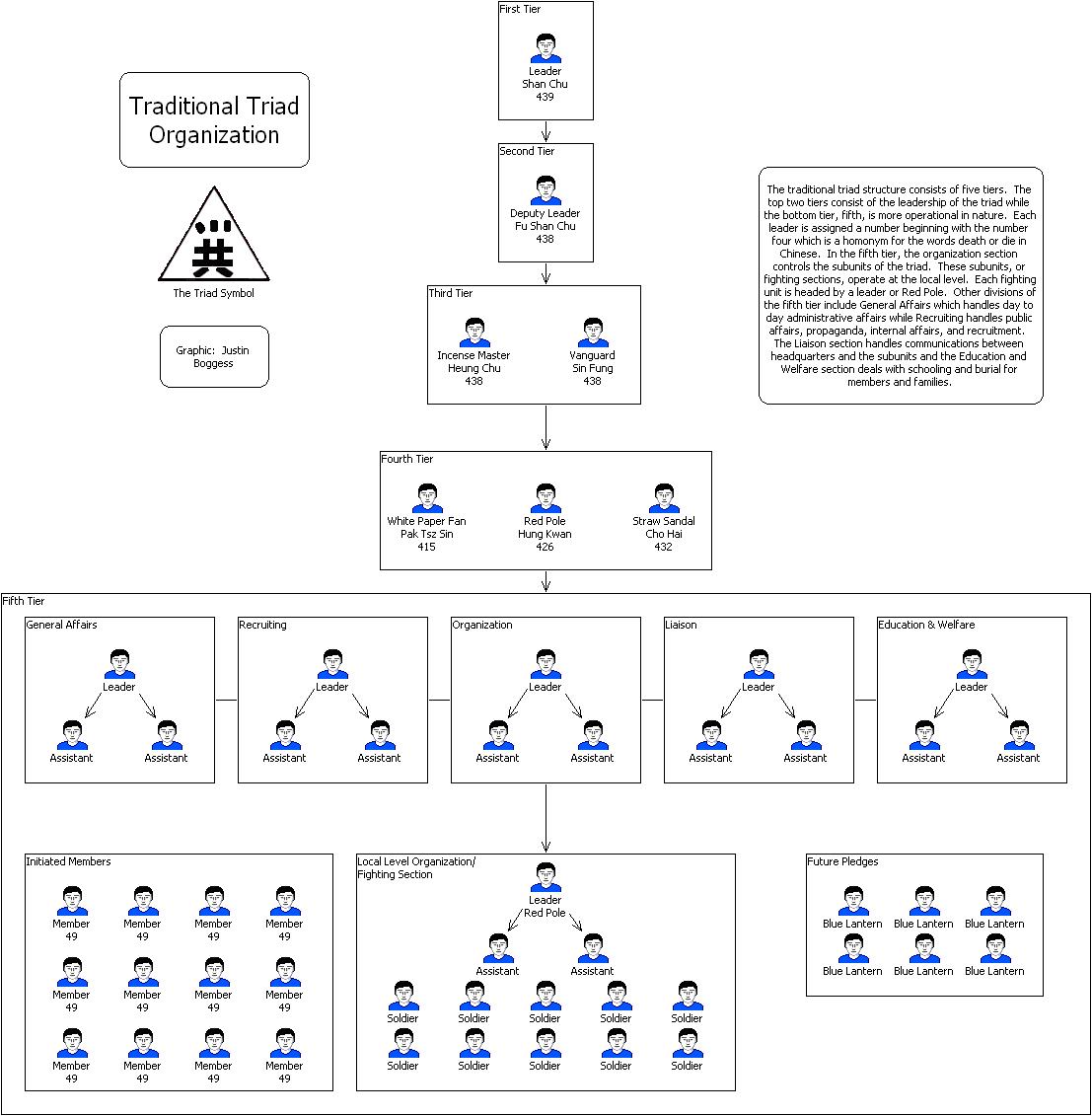
Tong-affiliated gangs, like the Fuk Ching, have an ah kung (grandfather) or shuk foo
(uncle) who is their tong leader. The top gang position is the dai dai lo (big big brother).
Communication between the tong and the gang occurs principally between these two
individuals. Below the dai dai lo in descending order are the dai lo(s) or big brothers, the
yee lo/saam lo (clique leaders), and at the bottom the ma jai or little horses. There are a
variety of norms and rules that govern the gangs. These include respecting the ah kung,
beating up members of other gangs on your turf, following the orders of the dai lo, and
not betraying the gang. Rules violators are punished, sometimes severely, such as through
physical assault and killing.
Triads Today
Today, the Triads are the most powerful criminal syndicate in the world, controlling much
of the world's drug trade and branching off in every major city. With the passing over
of Hong Kong back to mainland China, more and more Triads flee Hong Kong every year,
seeking their fortune in such profitable areas as the U.S.